How Many Seconds a Day Is Normal for an Automatic Watch?
From Seiko's −35/+45 to Rolex's −2/+2: the published accuracy standards side by side, what counts as normal for your watch, and when to worry.
The short answer
For an ordinary automatic watch, a rate within about ±10 seconds a day is normal; Longines puts a standard automatic at "as much as plus or minus 10 seconds a day" in its guide to automatic watch accuracy. A certified chronometer is held to −4/+6 seconds a day. Inexpensive Japanese movements are specified far more loosely, while Rolex, Omega and Grand Seiko promise tighter figures for their finished watches.
So "normal" isn't one number. It's whatever the movement inside your watch was made to keep, and the useful question is whether your watch keeps within it, steadily.
The published standards, side by side
These are the figures the makers and testing bodies publish, with links. Note what each one measures: some test the bare movement in a lab, some the finished watch.
| Standard or movement | Daily rate | What's tested, and how | Source |
|---|---|---|---|
| Seiko 4R36 (and siblings) | −35 to +45 s/d | Worn on the wrist at 5 to 35 °C | Seiko instructions |
| ETA 2824-2, Standard grade | ±12 s/d average | Adjusted in two positions | Caliber Corner |
| ETA 2824-2, Elaboré | ±7 s/d average | Three positions | Caliber Corner |
| ETA 2824-2, Top | ±4 s/d average | Five positions | Caliber Corner |
| COSC chronometer (ISO 3159) | −4 to +6 s/d | Uncased movement, 15 days, 5 positions, 8, 23 and 38 °C | COSC |
| Grand Seiko Standard (9S mechanical) | −3 to +5 s/d | Movement, six positions, three temperatures, before casing | Grand Seiko |
| METAS Master Chronometer | 0 to +5 s/d | Finished watch, eight tests including 15,000 gauss | Omega |
| COSC Excellence Chronometer | −2 to +4 s/d | Finished watch, six semi-dynamic positions, 200 gauss | COSC |
| Rolex Superlative Chronometer | −2 to +2 s/d | Finished watch, after casing | Rolex |
A few notes on reading that table:
- Grand Seiko also publishes the rate you should expect in normal use, which is wider than its lab figure: −1 to +8 s/d for calibers such as the 9SA5, and −1 to +10 s/d for others such as the 9S65, per the same Grand Seiko page. That's an honest admission that a wrist is not a lab.
- METAS allows 0/+5 to 0/+7 s/d depending on the caliber's size, according to Omega.
- Seiko's −35/+45 is a specification, not a prediction. Many 4R movements run much closer to zero, but a 4R36 at +25 s/d is within what Seiko promised.
- ETA grades come from caliber references rather than an ETA page; the same grades also allow a larger maximum daily variation than the average shown.
Why chronometer limits lean toward gaining
Look at the certificates: COSC −4/+6, METAS 0/+5, COSC Excellence −2/+4. Almost all of them allow more gain than loss. The standards don't explain themselves, but the practical effect is easy to see: a watch that runs slightly fast is easier to live with. You set it back a little once in a while, and you're never late.
That means a watch running a few seconds fast is not "worse" than one running a few seconds slow, as long as both stay within spec.
A chronometer certificate is more than one number
The −4/+6 that everyone quotes is only COSC's average daily rate. A movement also has to pass several other limits over its 15 days of testing. According to the COSC criteria summarized on Wikipedia, they include:
| Criterion | Limit |
|---|---|
| Average daily rate | −4 to +6 s |
| Mean variation in rates | 2 s |
| Greatest variation in rates | 5 s |
| Difference between horizontal and vertical | −6 to +8 s |
| Largest variation in rates | 10 s |
| Thermal variation | ±0.6 s per °C |
| Rate resumption | ±5 s |
The "variation" rows matter as much as the headline. They're the testing lab's way of asking whether the rate is steady, which is the same question you should ask of your own readings. And since the movement is tested before it's cased, a COSC certificate tells you how the movement performed in the lab, not exactly what your finished watch does on your wrist.
So what's normal for your watch?
Start with what the maker specifies for your caliber. Your watch is doing its job if, over a week of normal wear:
- Its average daily rate falls inside that spec. A Seiko 5 at +18 s/d is fine. A Rolex at +7 s/d is outside what Rolex promises and worth raising with a service center.
- The day-to-day spread is small. A few seconds of difference between days is normal. Swings of 10 seconds or more without an obvious reason (a day off the wrist, a cold night) point to a problem.
- Nothing changed suddenly. A watch that has run at +3 s/d for a year and is suddenly at +40 s/d has most likely been magnetized. It's quick to check: see is my watch magnetized.
If you don't know your caliber's spec, ±10 s/d is a fair working figure for a Swiss automatic. For an affordable Japanese movement, use the maker's figure, which is often much wider: −35/+45 s/d for Seiko's 4R family.
When is it worth doing something?
| What you see | Likely meaning | What to do |
|---|---|---|
| Steady, inside spec | Healthy | Nothing; check again in a few weeks |
| Steady, a little outside spec | Needs regulation | A watchmaker can adjust the rate, often without a full service |
| Sudden large gain | Probably magnetized | Check for magnetism; demagnetizing is quick and inexpensive |
| Rate jumps around | Unstable: position, wind, wear or a fault | Measure in the same position for a week; if it's still erratic, see a watchmaker |
| Getting steadily worse over months | Wear, aging oil | Plan a service |
Before you act, rule out the everyday causes. Position overnight, how fully wound it is, and temperature all move the rate by a few seconds; why your watch runs fast or slow goes through them. And make sure your readings are good ones: how to check your watch's accuracy covers the method.
In Escapement
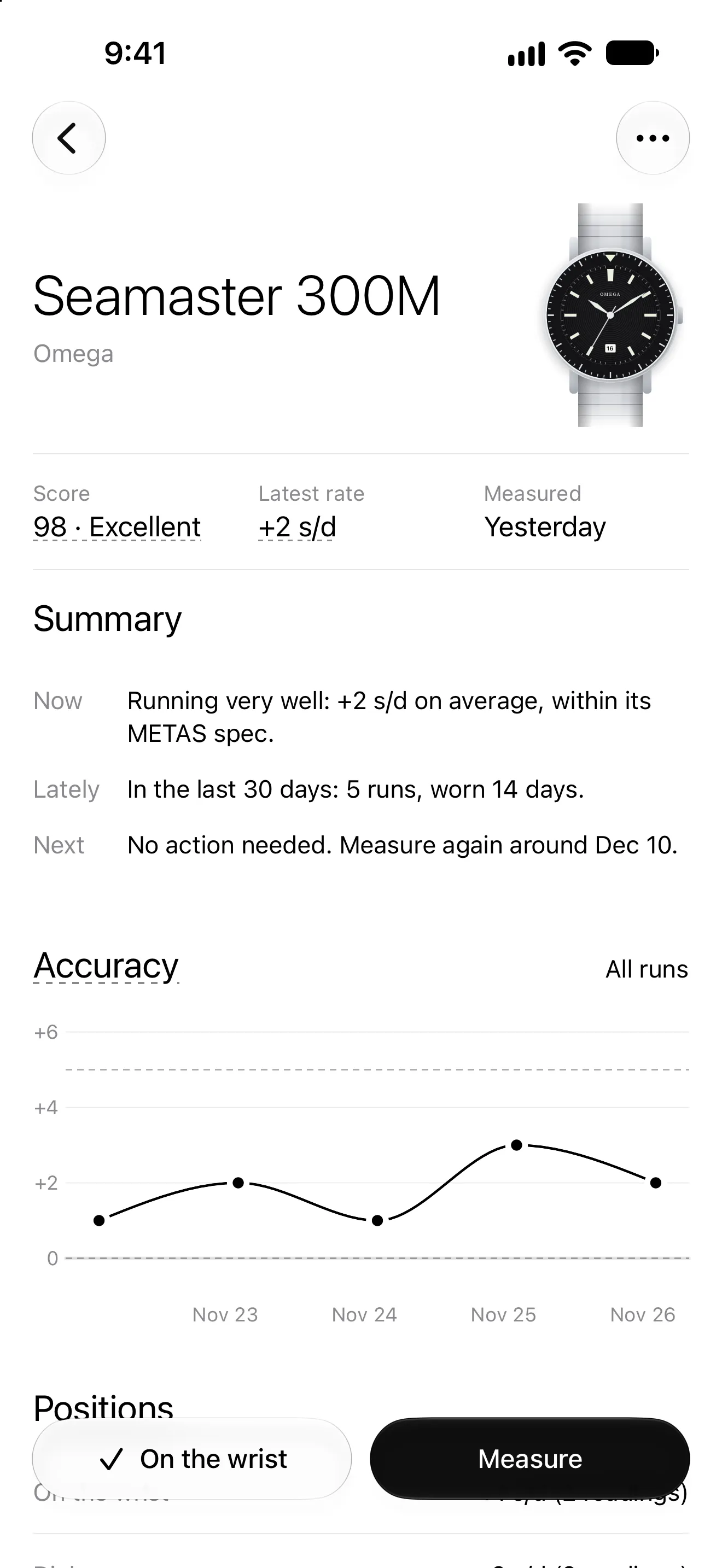
You can set the standard a watch was made to keep in Edit watch → Accuracy and care: COSC chronometer, METAS Master Chronometer, Rolex Superlative Chronometer, Grand Seiko mechanical, a few common grades, or your own limits. The watch's Accuracy chart then shades that band, and dots outside it change color.
The Health score respects the spec. A watch keeping comfortably inside its band isn't marked down for not being at zero, so a Japanese automatic at +15 s/d isn't scored like a broken watch. A watch whose average falls outside its spec can't reach the top bands, and when it runs steadily outside, its page says a regulation should fix it without a full service.
FAQ
Is +10 seconds a day bad for an automatic watch?
Not usually. It's within the ±10 s/d Longines describes for a standard automatic, and well inside many affordable movements' specs. It would be outside spec for a chronometer, a Grand Seiko or a Rolex.
Is it better for a watch to run fast or slow?
Most standards allow more gain than loss, and most people find a slightly fast watch easier to live with. What matters more is that the rate is steady and inside the spec for your movement.
How accurate is a COSC-certified watch?
The movement averaged between −4 and +6 seconds a day across 15 days of lab testing in five positions and three temperatures. On the wrist, in its case, it can differ a little from that, which is why some brands test the finished watch as well.
Do new mechanical watches need a break-in period?
No standard defines one. If a new watch runs outside its spec, measure it for a week or two of normal wear first; if it stays outside, raise it with the seller or the brand while the watch is under warranty.