Is My Watch Magnetized? How to Tell, and What to Do About It
A sudden gain of many seconds a day is the classic sign. How to test with a compass or your phone, what magnetizes a watch, and why the fix is quick and cheap.
The short answer
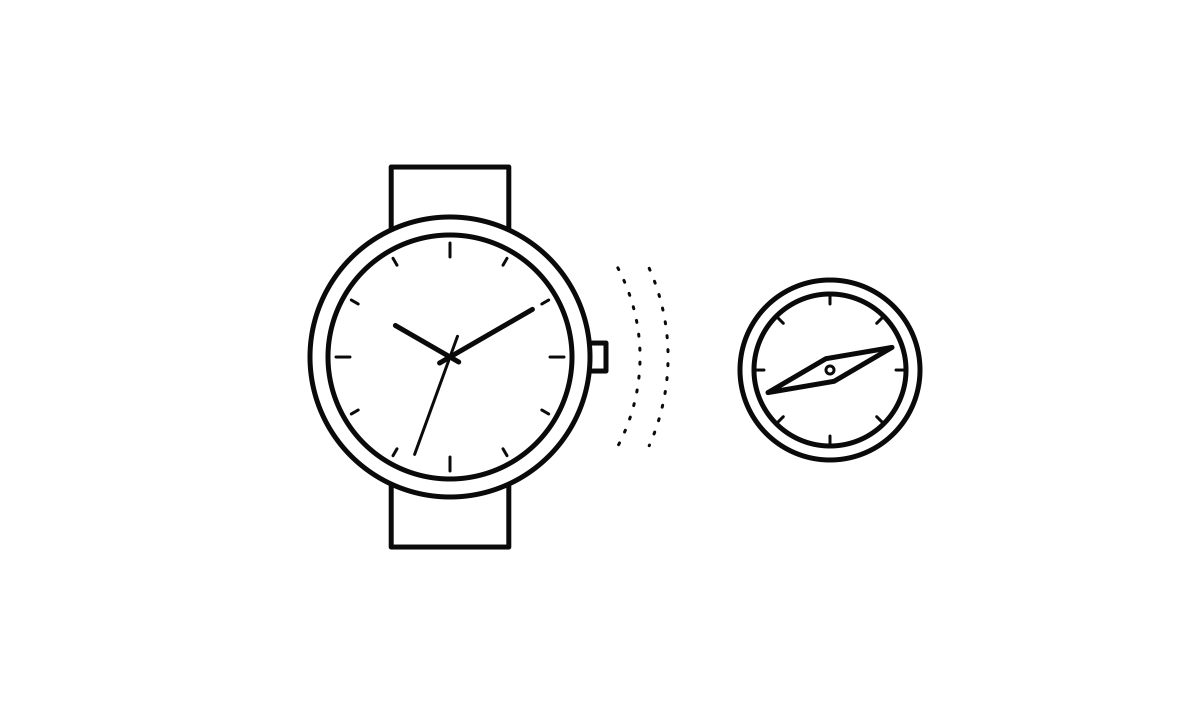
If a mechanical watch that used to keep good time suddenly gains a lot, from tens of seconds to minutes a day, magnetism is the first suspect. You can check in a minute: hold the watch close to a compass, or to your phone's magnetometer, and see whether it moves the needle or the reading. If it's magnetized, a watchmaker can demagnetize it in moments, usually without opening the case, and the effect isn't permanent.
Why magnetism makes a watch run fast
The part that keeps time in a mechanical watch is the balance wheel and its hairspring, a coil of very fine metal that breathes in and out several times a second. Traditional hairsprings are steel alloys, and steel can be magnetized.
When it is, the coils of the hairspring attract each other and stick together. A spring whose coils touch behaves like a shorter, stiffer spring, so the balance swings faster and the watch gains. As The Watch Club puts it, a slight magnetization might add something like 10 to 20 seconds a day, while a strong one can make a watch gain an enormous amount, on the order of minutes an hour.
That's why the classic sign is not just a fast watch, but a sudden change in a watch that was steady.
Signs your watch may be magnetized
- A sudden, large gain. The rate jumps from a few seconds a day to tens or hundreds, often after a specific day: a trip, a new bag, a night next to a speaker.
- An erratic rate. It gains a lot one day and less the next.
- A reading far from the watch's history. If you've been measuring, the new number simply doesn't fit the old ones.
None of these prove magnetism on their own: shocks, a tangled hairspring and old oil can cause similar symptoms. That's why a quick test is worth doing before you book a service. If the gain is modest and steady, the cause is more likely regulation or position; see why your watch runs fast or slow.
How to test for magnetism at home
The compass test
- Lay a compass flat on a table, away from metal and electronics, and let the needle settle.
- Take the watch off. Bring it slowly toward the compass, first dial side, then the case back, moving it around the compass.
- If the needle swings to follow the watch, the movement is probably magnetized. If it barely twitches, it probably isn't.
A small flick isn't proof. Steel parts in a case, a bracelet clasp or spring bars can nudge a sensitive needle too. A strongly magnetized movement usually turns the needle clearly.
The phone test
Your iPhone has a magnetometer, the sensor behind its compass. Apps that read it can show the field strength in microtesla (µT). Lay the phone flat, note the reading with the watch well away, then pass the watch slowly over the top of the phone. A large rise over the room's level means a magnetic field is coming from the watch.
Keep the phone still while you do this. Moving the phone changes its reading on its own.
The timing test
Measure the rate for a few days (here's how to check your watch's accuracy). Compare it with what the watch did before. A jump of +15 s/d or more against a steady history, with nothing else changed, is a strong hint.
What magnetizes a watch?
Magnets are in more everyday things than you'd think: phone cases, tablet covers, bag and purse clasps, speakers and headphones, laptop lids, induction hobs and chargers. Some figures:
| Source or standard | Field | Source |
|---|---|---|
| ISO 764 "magnetic resistant" watch must withstand | 4,800 A/m (about 60 gauss) | Wikipedia, antimagnetic watch |
| An iPhone 12, as measured by @watchoosy | 57 gauss | Time+Tide |
| A MagSafe charger, same test | 123 gauss | Time+Tide |
| COSC Excellence Chronometer test | 200 gauss | COSC |
| Rolex Milgauss rating | 1,000 gauss | Wikipedia |
| METAS Master Chronometer test | 15,000 gauss | Omega |
(The gauss figure for ISO 764 is a unit conversion: 4,800 A/m in air is about 6 millitesla, or 60 gauss.)
Two things follow. First, a watch marked "antimagnetic" to ISO 764 is only rated to about 60 gauss, and has to keep its rate within ±30 seconds a day of what it did before the test; that's protection against brief, everyday exposure, not immunity. Second, field strength drops off quickly with distance, so the risk comes from close contact: a watch resting on a laptop's magnetic lid, or in a bag pocket next to a magnetic clasp, rather than a phone across the table.
Many modern watches are far better protected. Silicon and other non-ferrous hairsprings, and the movements tested by METAS to 15,000 gauss, are much harder to disturb. Older and most affordable watches still use steel-alloy springs.
How to fix a magnetized watch
At a watchmaker: a demagnetizer is standard bench equipment. The watch is passed through or held on the device, which takes seconds, and usually it doesn't need to be opened. It's one of the quickest and least expensive things a watchmaker does.
At home: small demagnetizers are sold for watch owners. You hold the watch on or near the device, switch it on, and draw the watch away slowly before switching off. Follow the instructions of the unit you buy, then test again with the compass and measure the rate for a day or two. Avoid improvised methods with ordinary magnets: you can make things worse.
After demagnetizing, the rate usually returns to what it was. If it doesn't, the watch may have another problem and is worth a watchmaker's look.
How to avoid it
- Don't rest the watch on laptops, tablets, speakers or induction hobs.
- Keep it out of bag pockets with magnetic clasps.
- Store it away from phone chargers and smart speakers.
- If your watch suddenly gains, check for magnetism before anything else. It's the cheapest fix there is.
In Escapement
Magnetism, in the Measure menu, screens a watch with your iPhone's magnetometer. You lay the phone flat on a table, away from the watch, while it measures the room's field. Then you slowly pass the watch over the top of the phone for ten seconds, dial side and then case back, and the screen shows the rise over the room live. The result reads No sign of magnetism, Possibly magnetized or Likely magnetized, with a line of advice. It says so itself: "Screening only, not a calibrated instrument."
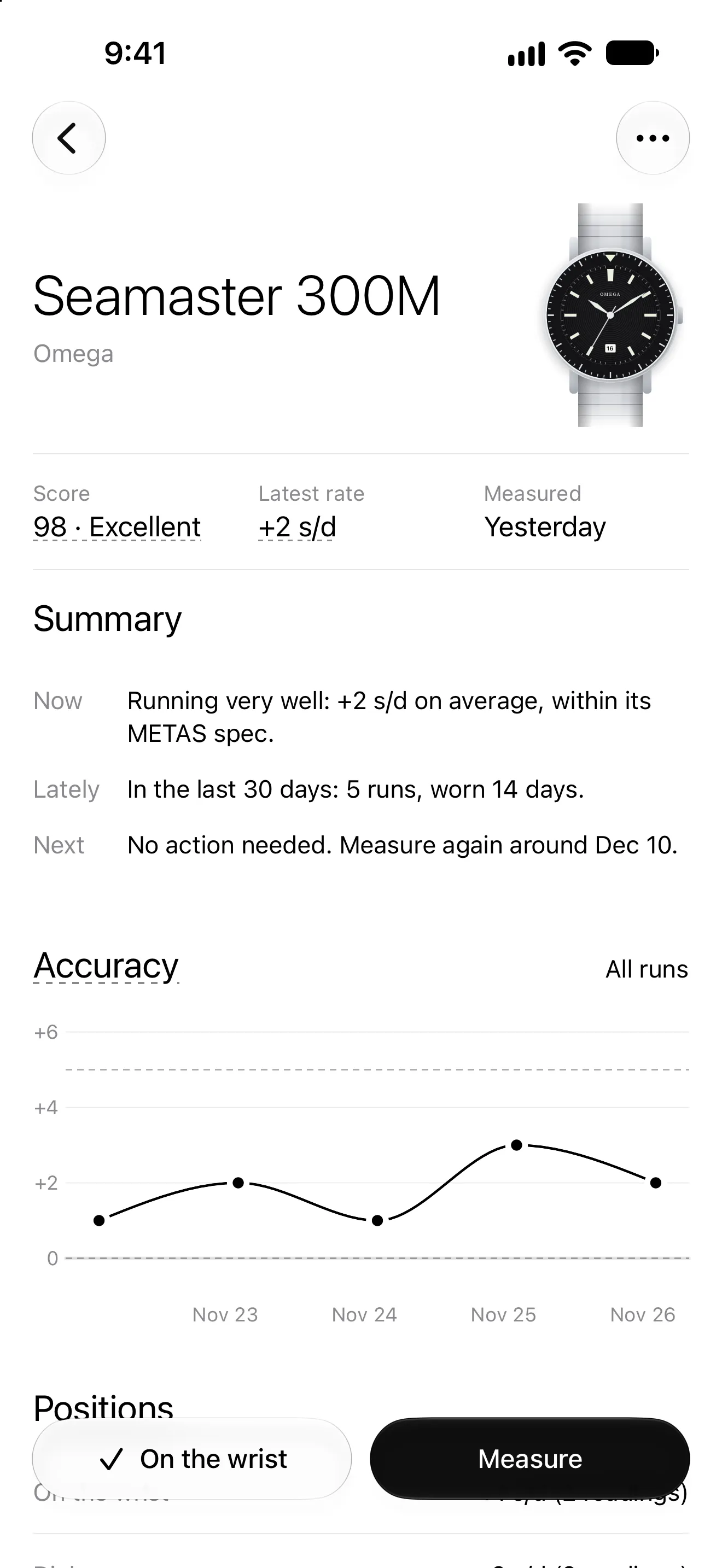
Escapement also watches the rate. When a watch with a steady history suddenly gains about 15 s/d or more against its previous readings, or the last magnetism check found a strong field, its page flags that the watch may be magnetized. The next step is to check for magnetism, or, when the check already found a strong field, to have it demagnetized.
FAQ
Can my iPhone magnetize my watch?
It can contribute. In one test reported by Time+Tide, an iPhone 12 measured 57 gauss and a MagSafe charger 123 gauss, at close range. Brief contact rarely matters, but resting a watch on or against magnets for long periods is a good way to magnetize it.
Is magnetism permanent or harmful?
No. It doesn't damage the movement, and once demagnetized the watch usually runs as before. It can, however, make the watch keep poor time until it's fixed.
What does "antimagnetic" on the dial mean?
Usually that the watch meets ISO 764: it withstands a field of 4,800 A/m, about 60 gauss, and afterward keeps its rate within ±30 seconds a day of what it was before. That covers everyday brushes with magnets, not long contact with strong ones.
How often should I demagnetize my watch?
Only when it needs it. If the rate is steady and the compass test shows nothing, there's nothing to fix.