Why Your Watch Runs Fast or Slow: Position, Temperature and Wind
Position, how fully it's wound, temperature, magnetism and age all move a mechanical watch's rate. How to tell which one is affecting yours, and what to do.
The short answer
A mechanical watch's rate isn't fixed. It shifts by a few seconds a day with the position the watch rests in, how fully the mainspring is wound, the temperature and how actively you wear it. Those everyday changes are normal. A sudden large gain usually means magnetism; a slow drift worse over months usually means the watch is due for a service; and a steady rate a little outside spec usually means it just needs regulating.
The trick is to work out which kind of change you're looking at before deciding what to do.
Position: gravity and friction
The balance wheel is the heart of the watch, swinging back and forth on two tiny pivots several times a second. How the watch is oriented changes how those pivots sit in their jewels, and so how much friction the balance meets.
As SJX explains in its piece on positional error, when the watch lies flat, dial up or dial down, the balance staff stands vertically on the tip of a pivot against its cap jewel: minimal contact, minimal friction. On its side (crown up, crown down and so on), the pivots press against the walls of their jewels, which adds friction. More friction means a smaller swing, and in many movements a different rate.
Gravity also acts on any slight imbalance in the balance wheel itself. A balance that isn't perfectly poised has a heavy spot, and depending on where that spot sits relative to gravity, the watch runs faster or slower in different vertical positions. That's why watchmakers test in several positions, and why COSC limits the difference between horizontal and vertical rates.
What this means for you
Every watch has its own positional character. Some gain dial up and lose crown down; others are nearly the same in every position. Forums and retailers give contradictory advice about which way to rest a watch overnight, because the answer depends on the individual movement.
The only reliable way to find out is to measure your own watch:
- Leave it in one position overnight, say dial up, and measure the change by morning.
- Repeat for a few nights in different positions: crown up, crown down, dial down.
- Compare the rates.
Once you know, you can use it. If your watch runs a little fast on the wrist and loses crown down, resting it crown down overnight can bring the daily average closer to zero. It's a free regulation.
State of wind: the mainspring's push
The mainspring delivers less force as it unwinds. Less force reaching the balance means a smaller swing, a lower amplitude. Ideally, the balance would keep the same timing whatever its amplitude; watchmakers call that isochronism. In reality, no balance spring is perfectly isochronous, so the rate changes as the watch runs down, and those changes add to the positional ones. SJX covers this too.
In practice:
- An automatic worn all day stays fairly well wound, so its rate is steadier.
- An automatic worn by someone who sits at a desk may never get fully wound, and can run differently from the same watch on an active wearer.
- A manual wind behaves differently in the hours after winding than near the end of its power reserve.
- A watch near the end of its reserve often shows the biggest change. If yours has stopped overnight, its last hours of running were the least representative.
If you're measuring, wind the watch fully before you start. If its rate falls off much faster than it used to, or its power reserve has shrunk, the mainspring or the oil may be tired, and that's a sign the watch is due for a service.
Temperature
Metal changes with temperature, and so does the hairspring's stiffness. Longines notes that watches in high temperatures tend to lose time and in low temperatures tend to gain.
Modern hairspring alloys keep this small. The COSC chronometer test, which runs at 8, 23 and 38 °C, allows a thermal variation of up to ±0.6 seconds a day per degree, per the COSC criteria. Your wrist keeps the watch warm and fairly constant while you wear it; the bigger swings come off the wrist: a cold car, a window ledge in the sun, a night on a cold nightstand.
If a watch behaves differently in winter and summer, temperature is part of the story.
Magnetism
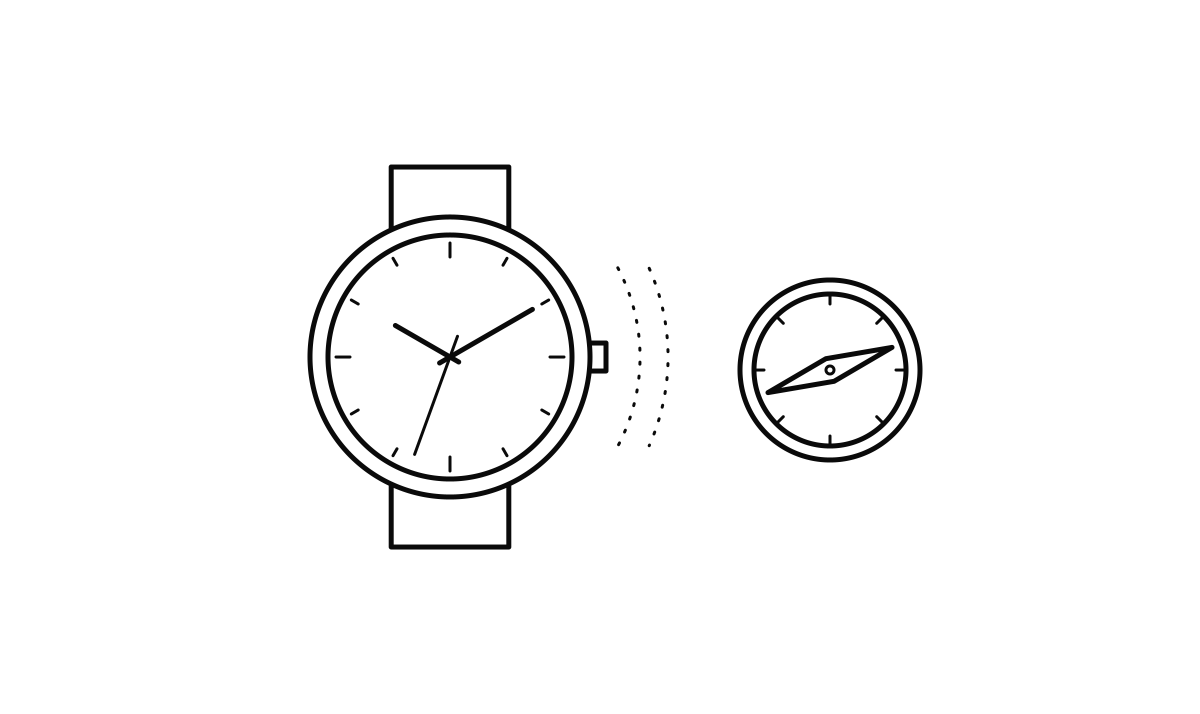
A magnetized hairspring has coils that stick together, which makes the watch gain, sometimes by minutes a day. The signature is a sudden jump in a watch that was steady. It's quick to test and cheap to fix; see is my watch magnetized.
Shock
A hard knock can disturb the balance or, in bad cases, catch one coil of the hairspring over another, which usually makes the watch run fast. Modern shock-protection systems guard the balance pivots, but they can't prevent everything. If the rate changed right after a fall or a hard knock and it isn't magnetism, see a watchmaker.
Age and oil
The lubricants inside a movement thicken and dry over the years, and parts wear. Friction rises, amplitude falls, and the rate typically becomes less stable and harder to keep in spec. This happens slowly: a watch that was steady at +3 s/d drifting to +8, then +12, over a year or two, often with a shorter power reserve. That's the pattern that says it's time for a service, not a regulation.
Regulation: when the watch is simply set off
Sometimes nothing is wrong at all. The watch is steady, healthy and consistently a little fast or slow, perhaps because it was regulated for a different wearer or drifted after a service. What counts as "a little" depends on the movement's spec; how many seconds a day is normal lists the common ones. A watchmaker can adjust the regulator to bring the rate back, often without a full service.
Telling the causes apart
| What you see | Most likely cause | Next step |
|---|---|---|
| A few seconds' difference between days | Position, wind, temperature: normal | Nothing |
| Different rate depending on how it rests | Positional variation | Measure each position; use the best one overnight |
| Sudden large gain, often fast | Magnetism | Test with a compass or phone; demagnetize |
| Very fast after a drop | Shock, tangled hairspring | Watchmaker |
| Steady but outside spec | Needs regulation | Watchmaker, usually quick |
| Slowly worse over months, shorter power reserve | Aging oil, wear | Plan a service |
| Runs differently when worn little | Low wind | Wear it more, or wind it by hand |
To use this table, you need a few good readings, ideally a week of them. How to check your watch's accuracy explains how.
In Escapement
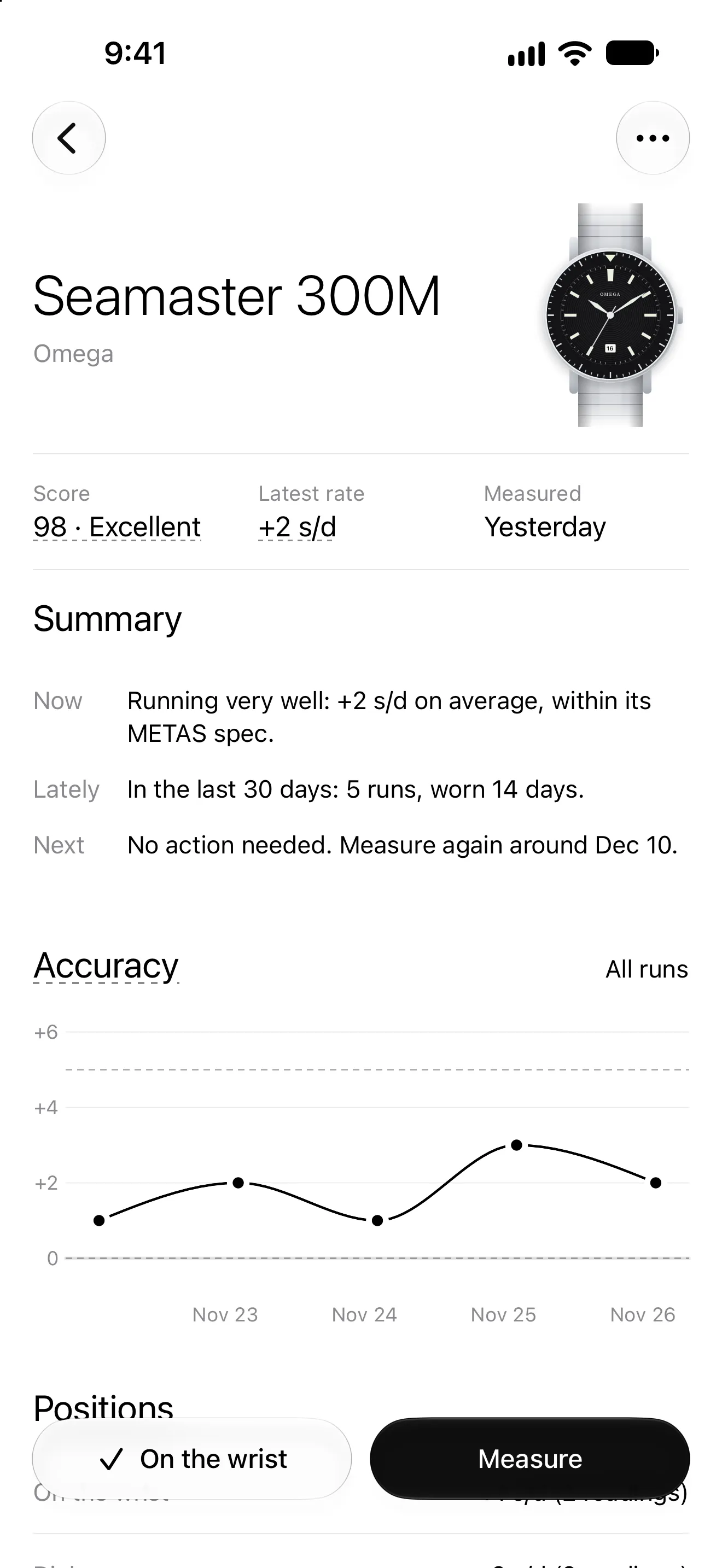
Under each new rate you can tag the Position, from On the wrist and Dial up to Crown down, and the Conditions: Cold, Warm, Active day, Desk day or Overnight. Once a watch has readings in two or more positions from the last 90 days, its page shows a Positions section with the average rate in each and the overall spread, for example "Mean +3 s/d · positional variation 8.0 s/d."
Escapement also reads the pattern for you. A sudden gain flags possible magnetism; a rate getting further from zero over recent readings says accuracy is getting worse; readings that jump around suggest measuring in the same position for a week; and a steady rate outside spec says a regulation should fix it without a full service.
FAQ
Why is my automatic watch suddenly running fast?
The most common cause is magnetism, especially if the change was sudden and large. Check with a compass or your phone. If it's not magnetized and the watch took a knock, a watchmaker should look at the hairspring.
Which position should I leave my watch in overnight?
The one that balances out its daily rate, which depends on your watch. Measure a few nights in different positions, then choose: if it runs fast on the wrist, rest it in the position where it loses.
Does a watch winder help accuracy?
It keeps an automatic wound, so the watch is running when you pick it up and isn't near the end of its power reserve. It won't fix a watch that's out of spec.
Why does my watch gain on some days and lose on others?
Different positions, levels of activity and temperatures from day to day. Small swings are normal; big unexplained swings are worth a closer look.